28 August 2026
The dentistry we want to practise
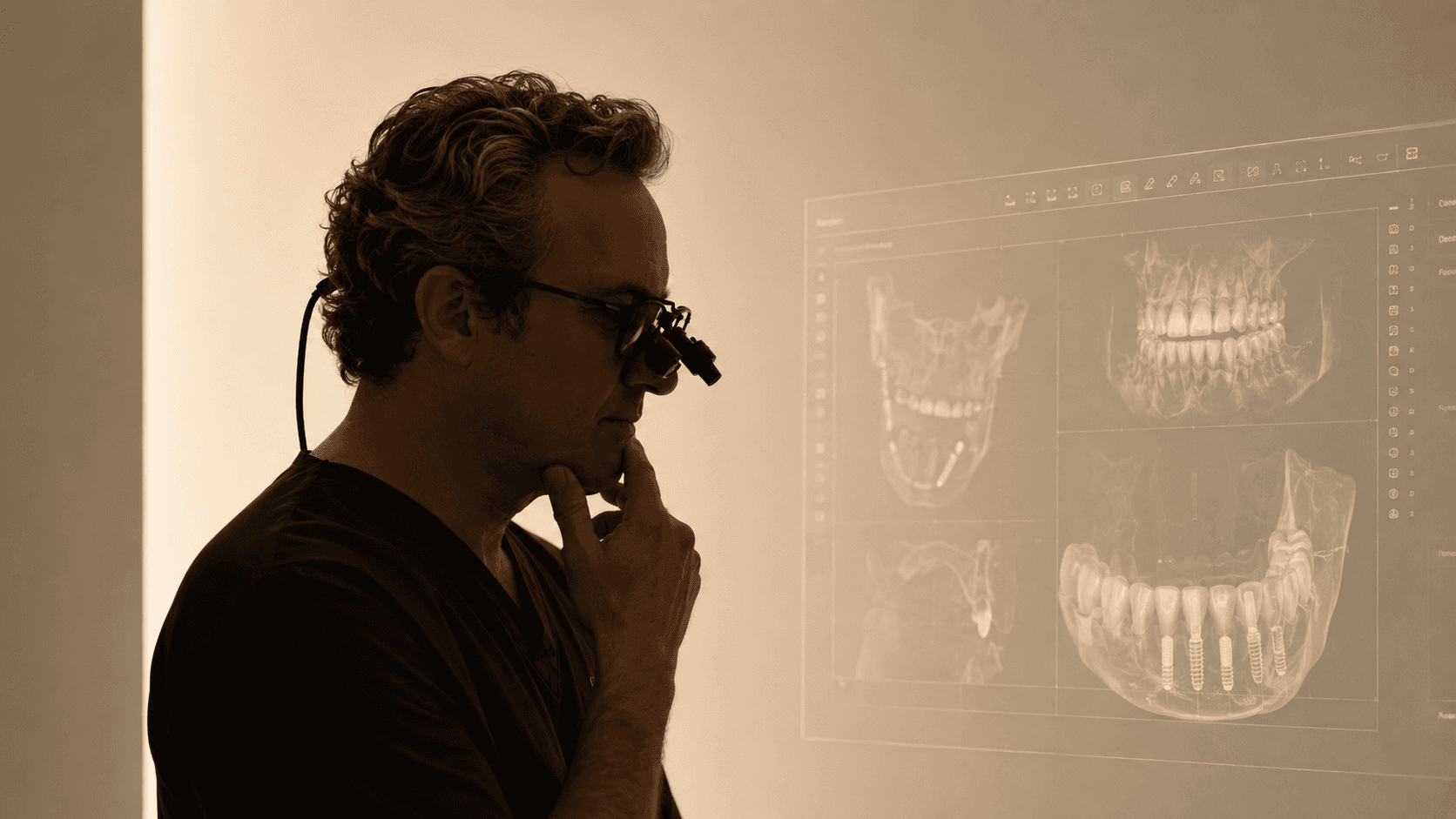
Today, we can diagnose in three dimensions, scan rather than take impressions, plan treatments digitally, manufacture restorations in the clinic itself, print surgical guides in 3D and incorporate artificial intelligence into certain clinical processes.
All of this is part of the way we work.
But we have never seen innovation as a race to accumulate technology.
For us, a tool only makes sense when it improves a decision, increases precision, reduces uncertainty or makes the patient's experience better.
Technology alone does not define good dentistry.
The judgement with which it is used does.
Time matters too
We live surrounded by ever-faster processes. In dentistry, however, there are things that should not be rushed.
Listening to a patient takes time. Studying a case takes time. Explaining the alternatives takes time. And so does planning well.
That is why we try to move away from an approach based solely on schedules, fixed time slots and standardised solutions.
Every patient arrives with a different story, their own expectations and different priorities.
Our job is not just to explain what can be done.
It is also to help decide what is worth doing.
Technology guided by judgement
Digitalisation allows us to see more, measure better and anticipate what lies ahead.
An intraoral scanner, a CBCT scan, digital planning, guided surgery, a CAD/CAM system or a 3D printer can offer extraordinary precision.
But their real value emerges when that precision translates into better clinical decisions.
The better we plan, the less we leave to chance.
The more information we have, the better we can explain.
And the more control we have over a procedure, the more reassurance we can offer.
For us, technology does not replace the relationship between clinician and patient.
It improves it.
A clinic that creates, too
Over the years, a different question arose: why limit ourselves to using tools developed by others?
Many of the problems of everyday clinical practice can only truly be understood by experiencing them from the inside.
This led to various technology projects and artificial intelligence initiatives developed from our own clinical experience.
From the consulting room. From real problems. From the need to find simpler, more precise or more intelligent ways of working.
Some of those tools have ended up being used by professionals far beyond our own clinic.
And that idea sums up our understanding of innovation rather well: not as a showcase, but as a way to improve what we do every day.
Experience and curiosity
Almost thirty years in the profession teach you many things.
One is that you never stop learning.
Experience brings judgement, but curiosity makes you keep moving forward.
Keep studying. Keep teaching. Keep adopting new techniques when they add value. Keep questioning protocols. And keep changing your mind when a better way of doing something emerges.
That, too, is part of our understanding of dentistry.
Doing things well is still modern
Innovation is sometimes confused with speed.
We prefer to associate it with precision.
Diagnose before intervening.
Plan before carrying out.
Preserve before replacing.
Measure before deciding.
Prevent before repairing.
And use technology when it genuinely improves the outcome.
Perhaps it is not the fastest way to practise dentistry.
But it is the dentistry we want to practise.
Rigorous, contemporary and technological.
While remaining approachable, calm and human.
Because, after all these years, one thing remains exactly the same.
In the end, it is all about people.